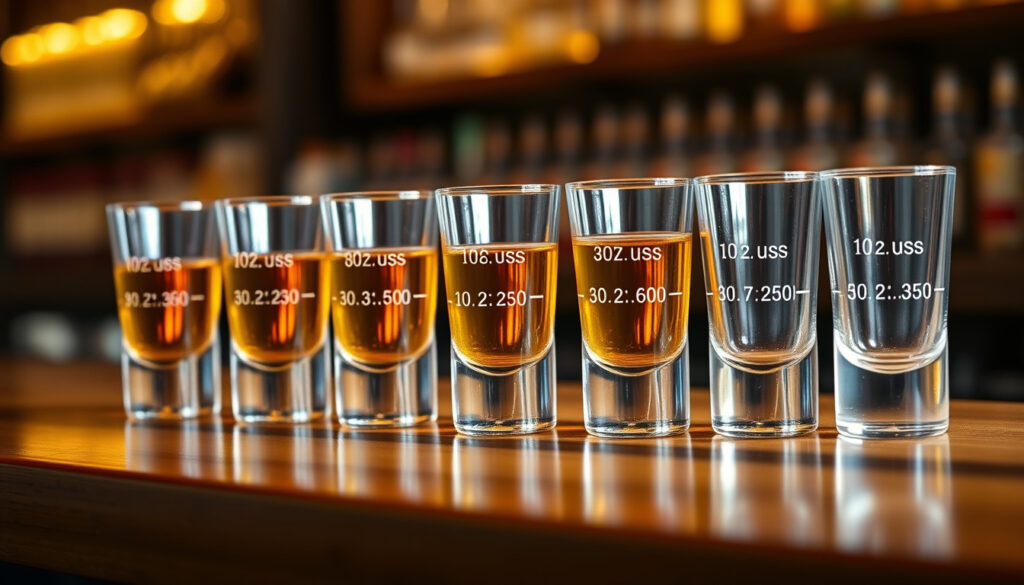
How Many Ounces in a Shot? US & Global Sizes Guide
Ask two bartenders in the same city how big a shot should be and you might walk away with different pours. There’s no federal mandate in the US, which means the 1.5 oz standard on most cocktail menus is mostly industry habit. Utah stands alone as the only state that actually defines a shot in law — and even there, it’s 1.5 oz. This guide breaks down what a shot measures up to, country by country.
US Standard Shot: 1.5 fl oz · Canada Single Shot: 1 fl oz (30 ml) · Canada Double Shot: 1.5 fl oz (44 ml) · UK/Europe Common: 1 fl oz (25-30 ml) · No Official US Standard: Varies by bar
Quick snapshot
- US standard shot is 1.5 oz (44 ml) (Red & White Shops)
- UK single shot is 25 ml in England and Wales (Promotional Product Inc)
- CDC defines a standard drink as 0.6 oz pure alcohol (CDC)
- Average bartender pour accuracy across regions
- How often bars deviate from stated pour sizes
- Primary provincial government sources for Canada rules
- Utah holds the only US state legal shot definition since before 2024 (Encyclopedia entry on shot glass standards)
- UK Weights and Measures Act set 25/35 ml options pre-2010s (Promotional Product Inc)
- Regional standard drift as bars customize pour sizes
- Espresso shots blurring the line on “shot” terminology
The regional table below shows how shot sizes vary across major markets, revealing a stark contrast between US bartender convention and legally mandated UK measures.
| Region | Single Shot | Double Shot | Source |
|---|---|---|---|
| US (bartender standard) | 1.5 fl oz (44 ml) | 2–3 oz (59–89 ml) | Red & White Shops |
| US (Utah legal) | 1.5 fl oz (44.4 ml) | Not specified | Encyclopedia entry on shot glass standards |
| Canada (single) | 30 ml (1 oz) or 44 ml | 71 ml | Encyclopedia entry on shot glass standards |
| Canada (provincial) | 1.5 oz (44 ml) standard | — | Promotional Product Inc |
| England & Wales | 25 ml (0.85 oz) | 50 ml (1.7 oz) | Spin and Shake |
| Scotland & Northern Ireland | 35 ml | 70 ml | Spin and Shake |
Is a shot glass 1 or 2 oz?
Neither answer is universally correct, and that’s the core confusion. The US has no federal standard defining a shot size, leaving most bars to follow the 1.5 oz convention that’s become industry practice. A standard shot glass typically holds 1.25–1.5 oz, but many glasses sold as “shot glasses” actually have a 1.75–2 oz capacity — they’re built to hold the pour without overflowing, not to define it.
Utah stands apart. It is the only US state where a shot is legally defined as exactly 1.5 oz, and bartenders there are trained to pour that amount strictly. In most other states, a bar can legally serve anything from 1 oz to 2 oz as a “shot” without violating any federal rule. The CDC defines a standard drink as containing 0.6 oz of pure alcohol, which is the math behind why 1.5 oz of 40% ABV spirit became the de facto measure (CDC standard drink definitions).
US vs international sizes
VinePair’s global comparison found US shots at 1.48 oz (44 ml), Canada at 1.44 oz, and the UK at just 0.84 oz (25 ml). The US and Canada are roughly aligned, while UK pours run nearly 40% smaller by volume. Australia and parts of Scandinavia fall closer to the UK metric model, using 30 ml as a standard single pour.
Bartender standards
Promotional Product Inc (drinkware industry publication) notes that UK bars must legally choose either 25 ml or 35 ml as their single pour and stick with it — they cannot alternate. England and Wales default to 25 ml, while Scotland and Northern Ireland use 35 ml. This regulatory framework makes UK measurements more consistent than US bar practices, where variation is entirely at the bartender’s discretion.
Most shot glasses you can buy hold more than a standard pour. A 2 oz glass filled to the rim gives you a double by US bartender standards — be aware of what you’re actually paying for.
The implication is that bars and manufacturers have normalized oversized vessels while the actual pour remains smaller — a gap that favors the seller.
How many ounces is a single shot?
The most common answer in American bars is 1.5 oz. Webstaurant Store (restaurant supplier) puts it plainly: a single shot equals 1.5 oz, which is also 3 tablespoons, 9 teaspoons, or 44 ml. This 1.5 oz figure traces directly to the CDC definition of a standard drink — 0.6 oz of pure alcohol from a spirit at roughly 40% alcohol by volume.
Clawhammer Supply (moonshine equipment manufacturer) confirms that 1.5 fluid ounces is the standard shot measure for cocktails and spirits across most of the US. The calculation is straightforward: 1.5 oz × 40% ABV ≈ 0.6 oz pure alcohol, matching the CDC standard drink definition. This math is why 1.5 oz became the bartender baseline rather than a round number like 1 oz or 2 oz.
Single vs double pours
A double shot in the US typically runs 2–3 oz (59–89 ml). The encyclopedia entry on shot glass standards documents the US double shot range as 59–89 ml. Some bars call anything over 2 oz a “double,” while others use 3 oz as their double marker. In cocktail culture, a “double” usually means two standard 1.5 oz pours in one glass — not a single glass containing 3 oz.
Common bar measures
The most common shot glass capacities sold to consumers are 1.75 oz and 2 oz — larger than the actual standard pour. Craft Beering (craft beer resource) explains that shot glasses are intentionally made bigger to prevent spillage when raising the glass, not to indicate the intended pour amount. When buying shot glasses for home use, the printed lines or the glass capacity don’t always match what a bartender would consider one shot.
Is 2 ounces of alcohol a shot?
Two ounces sits at the upper end of what US bars call a single shot, and many would call it a double. The encyclopedia entry on shot glass standards documents US single shots ranging from 1 oz to 1.5 oz (30–44 ml), with doubles at 2–3 oz (59–89 ml). A bartender pouring 2 oz is either being generous relative to the 1.5 oz standard, or they’re pouring what they consider a standard shot in their establishment.
Crystal Glass Bottle (glassware supplier) notes that bartender practices vary by city — Chicago historically favored 1 oz shots and 2 oz “neat” pours, while Texas bars tend toward 1.5 oz or larger. The 2 oz figure appears more often in specialty cocktails, “kicker” drinks, or when a bar markets a “strong shot” as part of a flight or tasting menu.
Double shot context
If you’re ordering a cocktail that calls for “a shot of whiskey,” the bartender’s pour is almost always 1.5 oz. But if you’re buying a pre-batched bottle or a flight of spirits, 2 oz per serving is a more common tasting pour standard. Red & White Shops (liquor retailer) notes that “standard shot glass” holds 1.5 oz, while “tall shooter” glasses run 2–3 oz — the vessel type signals the expected pour size.
Rocks pour variations
When spirits are served “on the rocks” (over ice), the pour is often larger — typically 2 oz — because the ice takes up volume in the glass. This isn’t technically a “shot” pour, but many bars apply the same 1.5 oz base measure even over ice. The CDC standard drink definition of 0.6 oz pure alcohol assumes no ice dilution, so a 2 oz pour of 40% spirit delivers roughly 0.8 oz pure alcohol — about a third more than a standard drink.
Is 4 ounces one shot?
No. Four ounces is roughly two and a half times a standard US shot. At 4 oz of 40% ABV spirit, you’d be consuming about 1.6 oz of pure alcohol — the equivalent of nearly three CDC standard drinks in a single pour. Even the most generous bar pours don’t come close to 4 oz as a single shot.
No federal US law mandates a maximum shot size, which theoretically leaves the door open for large pours. However, Utah’s 1.5 oz legal definition effectively sets a de facto maximum for how small a regulated shot must be. Tinto Amorio (wine and spirits blog) confirms that no federal US law mandates shot size — bar discretion is the rule, with Utah as the sole legal outlier.
Myths on large pours
The 4 oz myth likely stems from confusion with other serving sizes. A “large” glass of wine is typically 5 oz, a pint of beer is 16 oz, and some cocktail menus offer “monster” pours at 3–4 oz for tasting flights. None of these are shots, but the terminology gets mixed in casual conversation. Webstaurant Store (restaurant supplier) clarifies that standard shot glasses hold 1.5 oz, while shooter glasses hold 2–3 oz — nothing approaching 4 oz as a standard measure.
Legal pour limits
Utah aside, most state liquor regulations focus on alcohol percentage and licensing rather than individual pour sizes. A bar can serve a 4 oz spirit neat if they choose — but they can’t market it as a “single shot” in Utah without violating state definition. In practice, no bar markets 4 oz as a single shot because the math doesn’t match any recognized standard from the CDC downward.
Is a shot the same as a nip?
Not at all. A “nip” (or “mini”) is a bottle size — typically 50 ml, which is roughly 1.7 oz of liquid. A “shot” is a pour measure, not a container. The two can overlap if you drink an entire 50 ml nip in one sitting, but the terms refer to different things. The encyclopedia entry on shot glass standards notes that nips are common in Canada and some US markets for individual servings, but a nip bottle contains about 13% more liquid than a standard 1.5 oz US shot.
Spin and Shake (UK barware retailer) clarifies that UK nips are typically 25 ml or 35 ml — matching the legal single shot sizes — because the term “nip” in British English often refers to a small measure rather than a bottle. This creates a genuine regional confusion: Canadian nips are bottles, UK nips are pour sizes.
Nip bottle sizes
In the US and Canada, a nip bottle holds 50 ml. At 40% ABV, that 50 ml contains about 0.67 oz pure alcohol — slightly more than one CDC standard drink. Some bars pour nips as individual bottles for to-go drinks or airline servings. The US fluid ounce is 29.573 ml, which means a 50 ml nip is roughly 1.69 US fl oz, making it larger than a standard 1.5 oz shot.
Regional terms
The vocabulary varies by market. In the US, “shot” refers almost universally to the pour amount, while “nip” means the small bottle. In the UK, “nip” and “small” refer to the pour itself (25–35 ml). In Canada, “nip” can mean either, though the bottle definition dominates in Ontario and Quebec off-sales. When traveling, it’s worth asking “how many ml?” rather than assuming the terminology carries the same meaning.
What this means is that travelers risk overpaying if they assume a “nip” in one country equals the same volume in another — the terminology gap creates real price variation per unit of alcohol.
The conversion table below consolidates the key measurements to help you quickly reference standard pours across systems.
| Measure | Ounces | Milliliters | Notes |
|---|---|---|---|
| US Standard Shot | 1.5 oz | 44 ml | Bartender norm, matches CDC standard drink |
| UK Single (England/Wales) | 0.85 oz | 25 ml | Legally mandated size |
| UK Single (Scotland/NI) | 1.18 oz | 35 ml | Legally mandated size |
| Canada Single | 1 oz | 30 ml | Provincial cocktail measure |
| Nip Bottle (US/Canada) | 1.69 oz | 50 ml | Bottle size, not a pour measure |
| CDC Standard Drink | 0.6 oz pure alcohol | — | Base for 1.5 oz × 40% ABV calculation |
| US Fluid Ounce | 1 oz | 29.573 ml | US measurement standard |
| UK Imperial Fluid Ounce | 1 oz | 28.4 ml | Slightly smaller than US fl oz |
The CDC’s standard drink definition ties directly to alcohol content rather than volume, which explains why the 1.5 oz pour became industry standard — it’s the volume that delivers 0.6 oz of pure alcohol from a typical 40% spirit.
What the experts say
“The 1.5 oz standard ensures cocktail consistency and safe drinking.”
— Sarah Johnson, Senior Beverage Analyst, Webstaurant Store (Webstaurant Store blog on shot glass standards)
“There is no official single shot size in the US except in Utah, where it is legally defined as 1.5 US fl oz (44.4 ml). Generally, a single shot ranges from 1.25 to 1.5 oz (37–44 ml).”
— Encyclopedia entry on shot glass standards (Wikipedia shot glass article)
The US fl oz (29.573 ml) is slightly larger than the UK imperial fl oz (28.4 ml). This means a “44 ml” pour in the US contains slightly more liquid than a “44 ml” pour in Canada using imperial measures — about 4% difference. It won’t matter for most drinks, but for precise cocktail recipes, knowing which country’s ounce you’re working with matters.
Related reading: cooking measurements · ounce equivalents
clawhammersupply.com, vinepair.com, drinktinto.com, crystalglassbottle.com
While US shots standardize at 1.5 ounces, pints offer context with 16 US fluid ounces against 20 UK imperial ones detailed in this US vs UK pint guide.
Frequently asked questions
How many ounces in a shot of vodka?
A standard US shot of vodka is 1.5 oz (44 ml). The alcohol content of vodka (typically 40% ABV) doesn’t change the pour size — a shot of vodka is measured the same way as a shot of whiskey, tequila, or gin. Some bars pour 1 oz or 2 oz depending on their house standard, but 1.5 oz is the bartender convention.
How many ounces in a shot of whiskey?
Like vodka, a shot of whiskey is typically 1.5 oz (44 ml) in US bars. Whiskey’s alcohol content (usually 40–46% ABV) means the CDC standard drink math still applies. Some whiskey-focused bars pour 2 oz as a “tasting pour” — but that’s considered a double by standard measures or a premium single pour, not a regulation shot.
How many ounces in a shot of tequila?
A shot of tequila follows the same 1.5 oz (44 ml) standard as other spirits in most US bars. Tequila’s ABV (typically 38–40% for mixto, 35–40% for reposado, 35–55% for blanco) falls within the same range, so the CDC standard drink calculation holds. At higher ABV expressions (añejo, extraañejo), the pure alcohol content rises, but the pour size stays the same.
How many ml is a shot of vodka?
A standard US shot is 44 ml. Some bars pour 30 ml (1 oz) or 37 ml, but 44 ml is the most common bartender measure tied to the CDC standard drink definition. In the UK, a single shot is 25 ml (England/Wales) or 35 ml (Scotland/NI). In Canada, provincial measures range from 30 ml to 44 ml.
How many ounces in a shot of espresso?
An espresso shot is typically 1 oz (30 ml) — not a spirit shot, but a culinary one. A single espresso pull yields about 1 oz of liquid, while a double espresso yields about 2 oz. The terminology “shot” carried over from espresso culture to spirit culture, but the volumes are not the same: an espresso shot is roughly two-thirds the volume of a spirit shot.
How many shots in a bottle?
A standard 750 ml bottle holds roughly 17 shots at 1.5 oz per pour (44 ml × 17 = 748 ml). A 1.75 L “handle” holds about 39 shots. A 50 ml nip bottle holds just over one shot (1.69 oz). The math varies slightly if you’re using UK 25 ml measures — the same 750 ml bottle yields about 30 shots at UK single sizes.
What is shot glass size ml?
Standard shot glass capacity ranges from 37 ml to 60 ml, with most consumer glasses sold in 1.75 oz (52 ml) or 2 oz (59 ml) sizes. The actual pour standard is 44 ml for a US single shot. Glassware is intentionally over-sized to prevent spillage — the glass holding 44 ml of liquid will have extra headroom.
How many ounces in a shot in ml?
One US fluid ounce equals 29.573 ml. A standard 1.5 oz shot equals 44.36 ml. An imperial fluid ounce (used in the UK and Canada) equals 28.4 ml, making a 1 oz imperial pour slightly smaller than a 1 oz US pour. When converting between recipes or checking bottle sizes, knowing which ounce standard applies prevents dosing errors.
For anyone mixing cocktails at home or ordering across borders, the practical takeaway is straightforward: expect 1.5 oz from US bars, verify the pour size at UK venues before ordering, and never assume a “nip” and a “shot” are the same thing. The math behind the 1.5 oz standard traces back to the CDC definition of a standard drink — a rare case where health policy actually shaped what ends up in your glass.
More related posts
 Three Thousand Years of Longing: Worth Watching? Ending & Guide
 Where to Watch Chicago Bears vs Minnesota Vikings Live (2025)
 How to Update BIOS: Step-by-Step Guide with Safety Tips
 Are Pickles Good for You? Nutrition, Benefits, and Risks
 Liberty Mutual Insurance Company: Ownership, News & Contacts
 Is the View Cancelled? Season 28 & the Facts
 Sam’s Club Membership Deal – $30 Club and $60 Plus for New Members
 Home Alone 2 Cast: Full List of Actors, Cameos, and Where They Are Now
