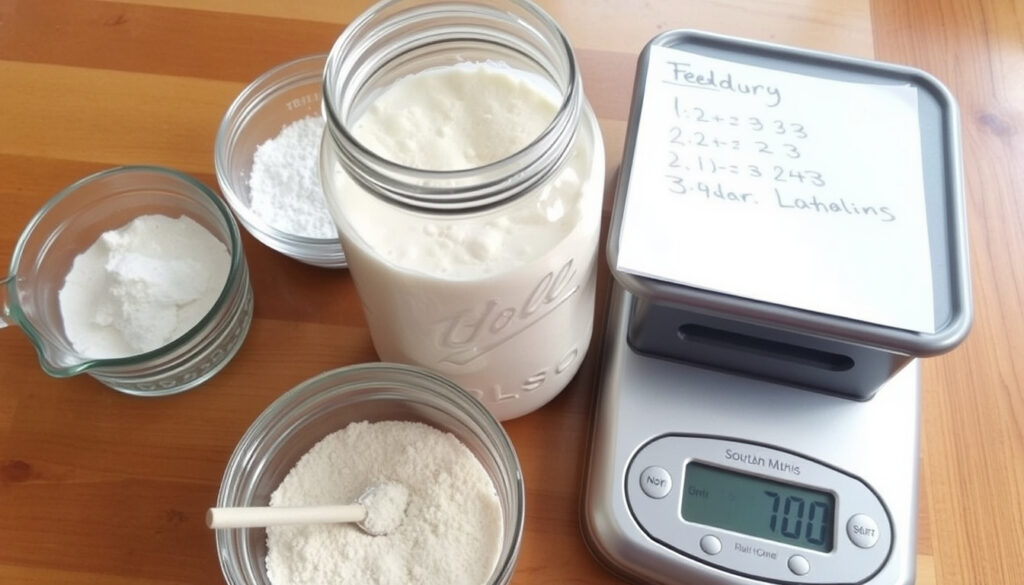
How to Feed Sourdough Starter: Ratios, Schedules, and Tips
Anyone who has kept a sourdough starter knows that feeding it can feel like adopting a very hungry pet—one that demands attention on your schedule, not its own. Yet the difference between a bubbly, reliable starter and a sad jar of hooch often comes down to a few simple habits.
Standard feeding ratio: 1:1:1 by weight (starter:flour:water) ·
Room temperature feeding frequency: Every 12–24 hours ·
Refrigerated starter feeding frequency: Once per week ·
Typical discard amount: At least half the starter before feeding ·
Estimated time to peak activity: 6–12 hours depending on temperature
Quick snapshot
- Discard all but 20–50g of starter
- Add equal weights of flour and water
- Stir vigorously to incorporate air
- Cover loosely and let ferment at room temperature
- Feed again when bubbles appear or after 12 hours
- 1:1:1 (starter:flour:water) – standard daily feeding
- 1:2:2 – for slower fermentation, less frequent feeds
- 1/3/3 – 1 part starter, 3 parts flour, 3 parts water
- Adjust ratio based on activity and schedule
- Kitchen scale (preferred) or measuring cups
- Clean glass jar or plastic container
- All-purpose or bread flour; whole grain for activity boost
- Non-chlorinated water (filtered or bottled)
- After feeding, starter peaks in 6–12 hours at 75–80°F (King Arthur Baking timing guide)
- Higher ratio feeds (e.g., 1:2:2) can stretch the timeline to 8–14 hours (Breadtopia timeline notes)
- Refrigerated starter takes 12–24 hours at room temperature to become active again (The Fresh Loaf community report)
Six key numbers every feeder should know — one pattern: consistency matters more than precision.
| Metric | Value |
|---|---|
| Standard feeding ratio | 1:1:1 by weight (starter:flour:water) |
| Feeding frequency at room temp | Every 12–24 hours |
| Feeding frequency in fridge | Once a week |
| Time to peak after feeding | 6–12 hours (varies with temperature) |
| Optimal starter temperature | 75–80°F (24–27°C) |
| Discard amount | At least half, often 2/3 to 3/4 |
The implication: feed on a schedule that fits your life, but keep the ratio steady.
How should I feed my sourdough starter?
What you need: flour, water, and a clean jar
- All-purpose or bread flour (whole wheat can boost activity)
- Non-chlorinated water (filtered or bottled works)
- A clean glass jar or plastic container
- Kitchen scale (preferred) or measuring cups
The basic 1:1:1 feeding ratio by weight
Baker Bettie explains that 1:1:1 means feeding the starter with equal amounts of flour and water relative to the starter kept Baker Bettie ratio guide. For example, if you keep 50g of starter, add 50g of water and 50g of flour.
Step-by-step feeding process
- Discard all but 20–50g of starter (or whatever amount you want to maintain).
- Add equal weights of flour and water (e.g., 50g each for 50g starter).
- Stir vigorously to incorporate air.
- Cover loosely and let ferment at room temperature.
- Feed again when bubbles appear or after 12–24 hours.
King Arthur Baking describes their standard procedure: “To the container with the starter, add 50g water and 50g all-purpose flour. Mix well, cover, and let the mixture rest.” King Arthur Baking recipe guide
When to feed vs. when to discard
You should feed whenever the starter looks hungry: liquid on top (hooch), a strong sour smell, or after it has peaked and begun to fall. Discarding is not optional for most methods — it keeps the colony in check. Baker Bettie notes that discarding reduces waste because keeping more starter requires more flour and water to feed it Baker Bettie waste advice.
Keeping a smaller starter (e.g., 25g instead of 200g) saves flour but demands more frequent attention — you can’t run on autopilot.
How often should I feed my sourdough starter?
Feeding frequency at room temperature (every 12–24 hours)
King Arthur Baking recommends room-temperature starter be fed every 12 hours, twice a day, for standard maintenance King Arthur Baking frequency guide. If your kitchen runs cool (65°F or lower), stretching to 24 hours is fine.
Feeding starter stored in the refrigerator (once a week)
Refrigerated starter can be fed weekly to stay viable. The cold slows metabolism dramatically. Remove from fridge, discard half, feed 1:1:1, and leave at room temperature for a few hours before returning to cold storage.
Adjusting schedule based on activity and temperature
A starter that doubles in 4 hours needs more frequent feeding; one that takes 12 hours can go longer. Higher ratio feeds (e.g., 1:5:5) can stretch the window. Breadtopia mentions that a 1:2:2 feed the night before yields ripe starter in the morning Breadtopia ratio for morning bake.
What happens if you miss a feeding?
Missing a day at room temperature won’t kill it — expect hooch on top (liquid layer of alcohol). Stir it back in or pour it off, then feed. Skip a week in the fridge? Feed twice to revive. Skip a month? You may need several feeds to restore activity.
The pattern: a starter is resilient; even neglect for a few days rarely destroys it completely.
For bakers who can’t bake daily, a refrigerated starter and a once-a-week feeding schedule is the most sustainable long-term habit.
What is the right ratio for feeding sourdough starter?
The standard 1:1:1 ratio (starter:flour:water)
This is the gold standard. It produces a predictable ferment and is easy to remember. King Arthur Baking explicitly states the feeding ratio in its maintenance recipe is 1:1:1 by weight King Arthur Baking ratio statement.
The 1/3/3 rule explained
The 1/3/3 rule means 1 part starter, 3 parts flour, 3 parts water. Baker Bettie says 1:3:3 is also a common feeding ratio for a more diluted refresh that slows fermentation Baker Bettie ratio comparisons.
Adjusting ratios for different hydration or consistency
- 1:1:1 – daily feeding, peak in 6–8 hours
- 1:2:2 – slower ferment, peak in 8–12 hours
- 1:5:5 – very slow, peak in 12–18 hours, good for weekend bakers
Breadtopia notes that a higher ratio feed such as 1:2:2 can be used the night before to have ripe starter ready in the morning Breadtopia higher ratio strategy.
Feeding without a scale: using cups and volume estimates
Volume approximations: 1 cup all-purpose flour ≈ 120g, 1 cup water ≈ 240g. If you keep ½ cup starter (about 60g), feed with ½ cup flour (60g) and ¼ cup water (60g). The ratio is less precise but workable.
The catch: volume feeding introduces variability, but it keeps you baking when a scale isn’t handy.
What are the biggest mistakes when feeding sourdough starter?
Overlooking discard and not feeding enough
Not discarding creates an overly large, hungry starter. Scotch & Scones emphasizes that discarding is part of the maintenance workflow Scotch & Scones maintenance process. Fermentation becomes unpredictable if the starter is too big for its food.
Using the wrong flour or water temperature
Chlorinated water can inhibit fermentation. Let tap water sit out for an hour or use filtered water. Cold water slows activity; room temperature or lukewarm water (about 70°F) is ideal.
Sealing the jar too tightly
Starter needs oxygen. A tight lid traps CO₂ and can cause explosion — always leave the lid loose or use a cloth cover secured with a rubber band.
Not stirring between feedings
Stirring incorporates oxygen and distributes yeast and bacteria. Failure to stir leads to uneven fermentation and increases the risk of mold. The Clever Carrot advises stirring until well incorporated The Clever Carrot feeding tips.
Keeping starter in a jar without cleaning
Same jar can be used if cleaned regularly. Dried starter on the sides can attract mold. Transfer to a clean jar every few feeds.
What this means: most starter failures come from neglect of basic hygiene, not from the ratio itself.
Even experienced bakers occasionally forget to feed their starter on a hot day — a 6-hour overproof can produce hooch and a vinegary smell, but it’s almost always salvageable with one good feed.
How do I feed sourdough starter from the fridge?
Feeding refrigerated starter weekly
Remove starter from fridge, discard half, feed 1:1:1 and leave at room temperature for a few hours before returning to cold storage. King Arthur Baking confirms this schedule keeps the culture viable King Arthur Baking fridge maintenance.
Reviving starter from fridge for baking
For baking, feed 12–24 hours ahead and let it peak. A 1:2:2 ratio the night before is ideal. Alexandra Cooks recommends feeding it with equal parts flour and water by weight, then letting it rest in a cozy place for 12–24 hours Alexandra Cooks sourdough guide.
Adjusting feeding before baking day
If you keep your starter in the fridge, take it out 2 days before baking: Day 1 – feed and leave at room temp; Day 2 – feed again in the morning; bake in the evening or the next morning.
Can I feed starter straight from the fridge?
Yes, but fermentation will be slower — expect 12–18 hours to peak instead of 6–8. Cold starter can be fed directly; just use slightly warmer water (80°F) to wake it up faster. The San Francisco Baking Institute suggests that feeding cold starter directly is possible but takes longer SFBI video transcript.
The implication: a cold starter is dormant, not dead; a little patience and warmth brings it back to life.
Confirmed facts vs. what remains unclear
Confirmed facts
- Feeding ratio of 1:1:1 by weight is standard and recommended (King Arthur Baking recipe, Baker Bettie ratio guide)
- Stirring between feedings helps incorporate oxygen and prevents mold (Scotch & Scones maintenance guide)
- Refrigerated starter requires weekly feeding to stay viable (King Arthur Baking maintenance guide)
- Discarding is necessary to manage volume and feed ratio (Breadtopia discard advice)
What’s unclear
- Optimal feeding frequency can vary with room temperature and flour type (Breadtopia variable feeding notes)
- Whether to keep starter in the same jar or move daily depends on cleanliness preference (Scotch & Scones jar advice)
- Exact effectiveness of zero-discard methods for long-term maintenance (Breadtopia zero-discard method)
Expert perspectives on feeding
“To feed it, you would add 40 g of flour + 40 g of water.”
The Clever Carrot (sourdough tips blog)
“To the container with the starter, add 50g water and 50g all-purpose flour. Mix well, cover, and let the mixture rest.”
King Arthur Baking Company (trusted flour brand and educator)
“Feed it with equal parts flour and water by weight, and let it rest in a cozy place for 12-24 hours.”
Alexandra Cooks (home baking expert)
For anyone juggling a starter alongside a busy life, the choice is clear: keep a small refrigerated starter, feed it weekly, and scale up the night before you bake — or embrace the zero-discard path by feeding a minimal 20g starter daily and skipping the waste entirely. For bakers who want to also explore fermented foods, check out Are Pickles Good for You? for another fermented staple. And for a sweet treat to use up that discard, Ben & Jerry’s Ice Cream is the opposite of fermentation but just as satisfying.
youtube.com, facebook.com, reddit.com, reddit.com, breadbakingathome.wordpress.com
For a detailed guide on feeding your sourdough starter, including ratios, schedules, and common mistakes, refer to this comprehensive resource.
Frequently asked questions
Can I overfeed my sourdough starter?
You can’t really overfeed it, but too-frequent feeds can dilute the yeast population. Stick to the standard schedule.
What type of flour is best for feeding?
All-purpose or bread flour works well. Whole wheat or rye add nutrients and can boost activity.
How do I know when my starter is ready to bake?
It should double in volume within 4–8 hours after feeding, be bubbly, and have a pleasant sour aroma.
What does hooch on top of my starter mean?
Hooch (a dark liquid layer) means the starter is hungry—discard or stir it in, and feed.
Should I use warm water to feed my starter?
Lukewarm water (75–80°F) can speed up fermentation. Avoid hot water that could kill the culture.
How long can I leave starter unfed in the fridge?
Several weeks, but it will become sluggish. Feed weekly for best results.
Can I feed my starter with whole wheat flour?
Yes, whole wheat makes it vigorous. Expect a faster rise.
Why does my starter smell like acetone?
That means it’s overripe—feed it promptly and the smell should disappear.
More related posts
 What Does i.e. Mean? Definition, Usage, and Examples
 Real Oviedo vs Barcelona: Head-to-Head, History & Predictions
 How to Get Rid of a Canker Sore – Effective Remedies and Prevention
 What Is Power BI? Uses, Excel Comparison & Beginner Guide
 Mets vs Dodgers Match Player Stats: Analysis & Key Performances
 Moving Company Near Me – Guide to Reliable Local Hires
 Who Won Super Bowl 2023 – Chiefs Defeat Eagles 38-35
 Katy Perry and Orlando Bloom Split: Timeline and Reasons
