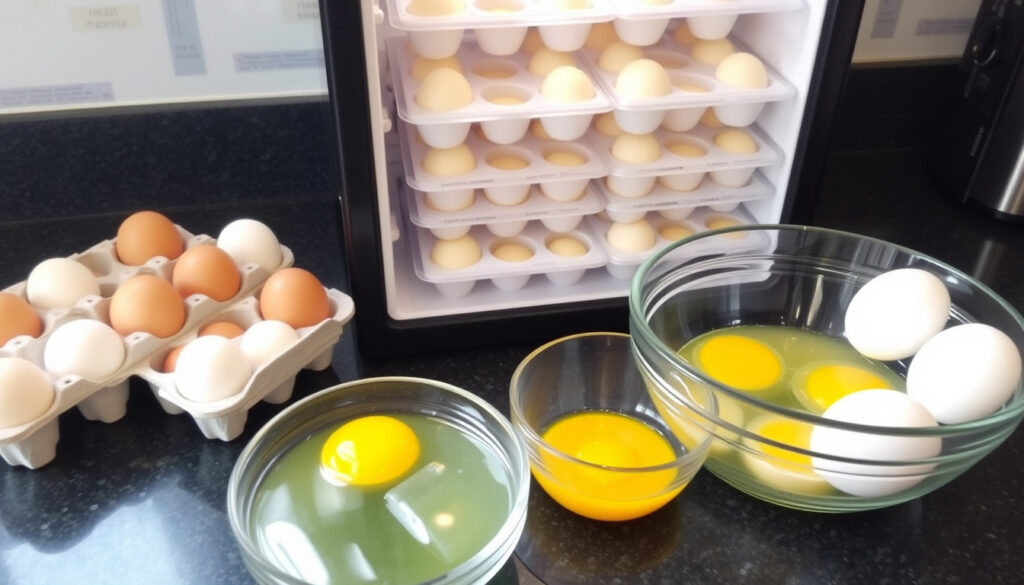
Can You Freeze Eggs? Safe Methods for Whites, Yolks & More
Few kitchen dilemmas are as common as wondering whether you can freeze those extra eggs before they go bad. The good news: yes, you can—but not in the shell, per FDA guidance, which mandates removing eggs from the shell before freezing.
Freezer shelf life (best quality): 4 months ·
Maximum freezer storage time: 1 year ·
Safe thawing methods: Refrigerator overnight or cold running water ·
Egg components suitable for freezing: Whole eggs, yolks, whites ·
Pre-freeze preparation needed: Remove shell, beat or separate ·
Storage container options: Airtight freezer bags or containers
Quick snapshot
- Eggs must be removed from shell before freezing (FDA)
- Add salt or sugar to yolks to prevent gelling (University of Arkansas Extension)
- Optimal container type (Ziploc vs. rigid) not directly compared by authorities
- Long-term taste difference beyond 4 months not systematically tested
- Hard-boiled eggs should not be frozen
- Frozen eggs can be stored up to 1 year
- Maximum freezer storage: 1 year (FDA)
- Best quality window: 4 months
- Canadian guidance: up to 6 months (Government of Canada)
- Thaw frozen eggs in refrigerator overnight or under cold running water
- Use thawed eggs in scrambled eggs, baking, or dishes where texture is less critical
- 3 tablespoons thawed egg = substitute for 1 large egg
Here are the key facts at a glance.
| Fact | Value |
|---|---|
| Maximum freezer storage time | 1 year |
| Best quality period | 4 months |
| Safe thawing method | Refrigerator overnight |
| Eggs per standard recipe substitute | 3 tablespoons thawed egg = 1 large egg |
| Salt/sugar additive for yolks | 1/2 tsp per 1/4 cup yolks (salt for savory, sugar for sweet) |
Can You Freeze Eggs?
The short answer is yes, but with important caveats. While you can freeze raw eggs for up to a year, the FDA is clear: never freeze them in the shell. The liquid inside expands and can cause the shell to crack, compromising safety. Instead, you must break the eggs, beat or separate them, and store them in airtight containers.
Is it safe to freeze raw eggs?
Yes, when done correctly. The USDA FSIS egg products guideline outlines commercial freezing requirements, but home freezing is safe as long as eggs are handled hygienically.
Do frozen eggs retain nutritional value?
Freezing does not significantly degrade the protein, vitamin, or mineral content of eggs. The Incredible Egg resource notes that frozen eggs remain a nutritious option, especially when used within the best-quality window of 4 months.
Home freezers may not freeze as fast as commercial units, which can affect texture. The CFR regulation for egg products requires commercial freezing to 10°F within 60 hours—a standard home freezers can meet for small batches.
The implication: texture matters more for delicate preparations, but for everyday cooking, the safety and convenience outweigh the trade-off.
What Is the Best Way to Freeze Fresh Eggs?
The method depends on which part of the egg you want to freeze. Here’s a step-by-step breakdown for each component, based on guidance from the Government of Canada publication and the University of Arkansas Extension.
How to freeze whole eggs
- Break the eggs into a clean bowl and beat until the yolk and white are fully blended.
- Pour the mixture into a freezer-safe container or resealable bag, leaving headspace for expansion.
- Seal tightly, label with the date and number of eggs, and freeze.
How to freeze egg whites
- Separate the whites from the yolks, making sure no yolk is mixed in.
- Pour each white into a standard ice cube tray (Incredible Egg recommends this for easier portioning).
- Once frozen, transfer the cubes to a freezer bag. Label with the number of whites.
How to freeze egg yolks
- Separate the yolks and remove any remaining white.
- Add 1/2 teaspoon of salt or 1 teaspoon of sugar per 1/4 cup of yolks (Healthline suggests salt for savory dishes, sugar for sweet).
- Gently stir the mixture to combine, then pour into a freezer container, seal, and freeze.
Yolks thicken into a gel when frozen without an additive. The University of Arkansas Extension explains that salt or sugar prevents this, keeping the yolks fluid after thawing.
The pattern: a small additive step ensures yolks stay usable, turning a potential failure into a reliable freezer staple.
Is There a Downside to Freezing Eggs?
Freezing eggs is not without trade-offs. The main downsides involve texture, convenience, and the risk of freezer burn. Here’s a balanced look.
Upsides
- Extends shelf life by months or up to a year
- Reduces food waste from surplus eggs
- Frozen eggs work well in baking and scrambled dishes
- Easy to portion (especially whites via ice cube trays)
Downsides
- Texture changes: scrambled eggs can become slightly rubbery
- Yolks require salt/sugar additive to remain usable
- Freezer burn risk if not sealed properly
- Not suitable for dishes where appearance is critical (e.g., sunny-side up)
Texture changes after freezing
When you thaw and cook frozen eggs, the texture is often denser than fresh. Incredible Egg notes that frozen eggs are best for scrambled eggs, omelets, and baked goods—not for preparations where a runny yolk or fluffy white is the star.
Potential for freezer burn
If the container isn’t airtight, ice crystals can form on the egg surface, causing dry, off-flavor spots. The solution: use heavy-duty freezer bags, squeeze out excess air, or vacuum-seal.
Preparation effort required
Freezing eggs takes a few extra steps: cracking, beating, separating, and labeling. For many, the time saved later by having pre-portioned eggs outweighs the upfront effort.
The trade-off: for bakers and meal-preppers, the convenience of grab-and-go frozen eggs is a clear win. For those who prize the texture of a fresh egg breakfast, the loss is noticeable.
Do Scrambled Eggs Freeze Well?
Yes—scrambled eggs are one of the best candidates for freezing. The key is to cook them slightly underdone before freezing, so they don’t become rubbery when reheated.
How to freeze scrambled eggs
- Cook scrambled eggs over medium heat until just set but still moist (about 70% done).
- Cool completely at room temperature, then spread in a thin layer in a freezer bag or container.
- Portion into patties or use a muffin tin for individual servings.
Thawing and reheating frozen scrambled eggs
- Thaw in the refrigerator overnight or place the sealed bag in cold water for 30 minutes.
- Reheat in a microwave on medium power in 30-second bursts, or in a skillet over low heat with a splash of milk or butter.
“Scrambled eggs freeze exceptionally well if you don’t overcook them first. The slight undercooking ensures they stay tender after reheating.”
How Long Can You Freeze Eggs?
Freezer storage times vary by the type of egg product and the guidance source. The consensus among the FDA, University of Arkansas Extension, and Incredible Egg is that whole eggs, whites, and yolks maintain best quality for 4 months but remain safe to eat up to 1 year.
Freezer storage timeline for different egg types
The table below summarizes the recommended storage durations for each egg preparation.
| Egg type | Best quality | Maximum safe storage |
|---|---|---|
| Whole raw eggs (beaten) | 4 months | 1 year |
| Egg whites | 4 months | 1 year |
| Egg yolks (with salt/sugar) | 4 months | 1 year |
| Scrambled eggs (cooked) | 3 months | 6 months |
| Hard-boiled eggs | Not recommended | N/A |
Signs of freezer-burned eggs
After several months, even well-sealed eggs can develop ice crystals. If the eggs have a dry, spongy texture or an off smell after thawing, discard them. The Alabama public health department advises that freezer burn does not make eggs unsafe, but quality suffers.
The catch: even with good practices, texture changes are inevitable, but the safety and convenience gains make freezing a worthwhile option for most households.
What’s Confirmed and What’s Unclear
Confirmed facts
- Eggs must be removed from shell before freezing (FDA)
- Add salt or sugar to yolks to prevent gelling (University of Arkansas Extension)
What’s unclear
- Optimal container type (Ziploc vs. rigid) not directly compared by food safety authorities
- Long-term taste difference beyond 4 months not systematically tested by cited sources
- Hard-boiled eggs should not be frozen
- Frozen eggs can be stored up to 1 year
“Egg whites can be frozen in an ice cube tray for easier portioning—each cube equals one egg white.”
“Eggs should not be frozen in their shells. The liquid expands and can cause the shell to crack.”
— U.S. Food and Drug Administration
For home cooks, the choice is clear: freezing eggs is a safe, effective way to extend their usability, but it requires a little upfront effort. The reward is less food waste and a ready supply of eggs for baking and quick meals. If you’re a meal-prepper, invest in ice cube trays and freezer bags—you’ll thank yourself later.
usda.gov, aahealth.org, publications.gc.ca, govinfo.gov, healthline.com, reencle.co, govinfo.gov, govinfo.gov
Frequently asked questions
Can I freeze eggs directly in their shell?
No. The FDA warns that freezing eggs in the shell can cause the shell to crack, leading to bacterial contamination. Always remove the shell and beat or separate the eggs first.
How do I thaw frozen eggs?
Thaw in the refrigerator overnight, or place the sealed container under cold running water for a quicker method. Never thaw at room temperature. Use thawed eggs immediately.
Can I use frozen eggs for baking?
Absolutely. Thawed frozen eggs work well in cakes, cookies, muffins, and other baked goods. Measure 3 tablespoons of thawed egg for each large egg your recipe calls for.
Do frozen eggs taste different from fresh?
When used within 4 months, the taste difference is minimal. After that, subtle flavor changes can occur. For best results, use frozen eggs in dishes with stronger flavors (spices, cheese, chocolate) where the difference is less noticeable.
Can I freeze egg substitutes or liquid egg products?
Yes, if the product is pasteurized and unopened. Check the label for freezing instructions. Once opened, treat like raw eggs: pour into a freezer container and freeze.
Is it safe to refreeze eggs that have been thawed?
No. The FDA advises against refreezing any food that has been thawed, including eggs, due to the risk of bacterial growth.
Can I freeze deviled eggs or egg salad?
Not recommended. The texture of the egg white becomes rubbery, and mayonnaise-based fillings separate when thawed, resulting in an unappetizing dish.
More related posts
 Dodgers vs Phillies Match Player Stats: All-Time & Recent
 Is Five Nights at Freddy’s Kid Friendly? Age Guide & Facts
 What Stores Are Open on Thanksgiving 2025
 Foster’s Home for Imaginary Friends: Stream, Cancel, Characters
 Small Wardrobe Organization: 50% Rule & 3-3-3 Method
 Water Shoe for Women: Be t Pick Te ted & Reviewed
 Michael Jordan The Last Dance: Facts & Controversies
 Does UPS Deliver on Saturdays? Policy & Times
