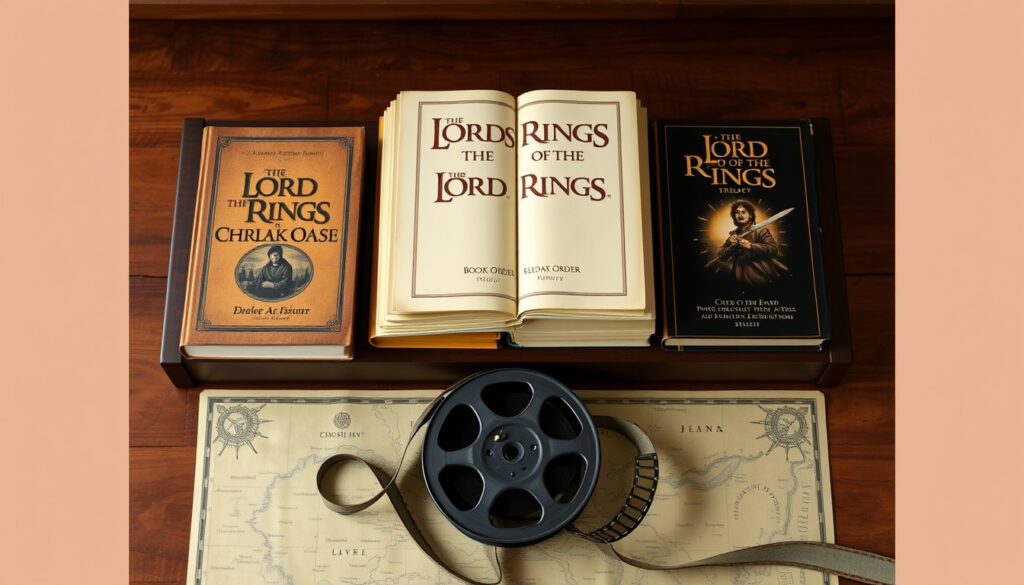
Lord of the Rings in Order: Release, Chronological & Books Guide
Few decisions feel more weighty for a first-time Middle-earth traveler than choosing where to start. The six Peter Jackson films span two trilogies released a decade apart, and the order you pick can shape your entire experience.
Number of main movies: 6 (3 Hobbit + 3 Lord of the Rings) ·
First movie released: The Fellowship of the Ring (2001) ·
Last movie released: The Hobbit: The Battle of the Five Armies (2014) ·
Total runtime (theatrical cuts): Approximately 19 hours
Quick snapshot
- Three LOTR films released 2001, 2002, 2003 (Encyclopaedia Britannica)
- Three Hobbit films released 2012, 2013, 2014 (MovieBase) (Encyclopaedia Britannica)
- The Hobbit is set 60 years before LOTR (MovieBase) (Encyclopaedia Britannica)
- Best watch order for first-timers is subjective (Rotten Tomatoes Editorial)
- Theatrical vs extended edition preference varies (MovieBase) (Rotten Tomatoes Editorial)
- Opinions on skipping The Hobbit are divided (IGN)
- First film: The Fellowship of the Ring (2001) (Encyclopaedia Britannica)
- Last film: The Hobbit: The Battle of the Five Armies (2014) (MovieBase)
- Return of the King won 11 Academy Awards (MovieBase)
The six films break into two blocks, and the numbers tell only part of the story. Here are the essential figures:
| Metric | Value |
|---|---|
| Total movies | 6 (3 Hobbit + 3 LOTR) – MovieBase |
| First movie released | The Fellowship of the Ring (2001) – Encyclopaedia Britannica |
| Last movie released | The Hobbit: The Battle of the Five Armies (2014) – MovieBase |
| LOTR trilogy box office | Nearly $3 billion worldwide – Rotten Tomatoes Editorial |
| LOTR trilogy Academy Awards | 17 Oscars from 30 nominations – Rotten Tomatoes Editorial |
In what order do I watch Lord of the Rings?
Release order
- The Fellowship of the Ring (2001) – Encyclopaedia Britannica
- The Two Towers (2002) – Encyclopaedia Britannica
- The Return of the King (2003) – Encyclopaedia Britannica
- Then the Hobbit trilogy: An Unexpected Journey (2012), The Desolation of Smaug (2013), The Battle of the Five Armies (2014) – MovieBase
This is the order Peter Jackson’s films premiered in theaters. Most fan guides, including IGN (newcomer guide), recommend starting here because the original trilogy was designed to be experienced without knowledge of its prequels.
Chronological order
- The Hobbit: An Unexpected Journey (2012)
- The Desolation of Smaug (2013)
- The Battle of the Five Armmies (2014)
- The Fellowship of the Ring (2001)
- The Two Towers (2002)
- The Return of the King (2003)
This order follows the story timeline inside Middle-earth. IMDb (list) places the Hobbit films first in its chronological list. The advantage: you see the earlier events, including the discovery of the One Ring, before the war begins.
Recommended order for first-time viewers
Most veteran fans and critics say release order. Rotten Tomatoes Editorial presents the 2001-2003 trilogy as the main series and groups the Hobbit films afterward. The reason: the later films were made a decade later and spoil key moments from the earlier entries.
The implication: release order protects the narrative payoff designed by Jackson, while chronological order offers a linear timeline at the cost of revealing some surprises early.
For first-time viewers, most guides recommend release order to preserve the intended narrative experience (Rotten Tomatoes Editorial).
Which should I watch first, Hobbit or Lord of the Rings?
Arguments for watching Hobbit first
- The Hobbit trilogy is set 60 years before LOTR, so the chronology is natural (MovieBase)
- You learn about the Ring’s origins and the dwarves’ quest first
- Popverse starts its “most complete order” with The Rings of Power, then the Hobbit films, then LOTR
Arguments for watching Lord of the Rings first
- The original trilogy was made first and sets up the world without assuming prior knowledge
- Release order avoids references in The Hobbit that spoil plot points of LOTR (MovieBase)
- Many viewers find the slower pace of The Hobbit more enjoyable after experiencing the epic conclusion of LOTR
Spoiler considerations
The Hobbit films include flash-forwards and references (like the Necromancer) that reveal elements of LOTR. Release order keeps those reveals intact. Rotten Tomatoes Editorial notes that the 2001-2003 trilogy won 17 Oscars from 30 nominations – it’s the experience millions fell in love with first.
The trade-off: watch Hobbit first for narrative chronology, or LOTR first for storytelling impact. There’s no wrong answer, but your choice changes how you see Middle-earth.
What is the chronological order?
The Hobbit trilogy
- The Hobbit: An Unexpected Journey (2012)
- The Desolation of Smaug (2013)
- The Battle of the Five Armies (2014)
These films take place during the Third Age, about 60 years before the War of the Ring. MovieBase confirms the prequel relationship.
The Lord of the Rings trilogy
- The Fellowship of the Ring (2001)
- The Two Towers (2002)
- The Return of the King (2003)
The epic conclusion of the Third Age. Encyclopaedia Britannica records each premiere date.
Other works in the timeline
The animated The Lords of the Rings (1978) and The Return of the King (1980) are earlier adaptations set in the same universe. Popverse includes them in a broader release order that also features The Rings of Power series (Second Age) and the upcoming War of the Rohirrim.
What this means: the chronological web is wider than the six Peter Jackson films, but for most first-time viewers, those six are the core.
Can I skip The Hobbit?
Pros of watching The Hobbit
- It provides background on the creation of the One Ring and the Necromancer
- You meet Bilbo Baggins and his younger adventuring self
- It enriches the emotional weight of the Ring’s history later (MovieBase)
Cons of skipping The Hobbit
- You miss context for characters like Legolas and Elrond who appear in LOTR
- Some references (e.g., “the dwarves of Erebor”) will feel unexplained
- The trilogy is nearly 8 hours – a big commitment if you’re after a quick entry
Alternative: watch a fan edit
Some fans have condensed the Hobbit trilogy into a single 4-hour edit, cutting the extra material. This gives you the story without the trilogy’s length. We won’t recommend any specific edit, but the option exists.
The pattern: if you value completeness, watch all six. If you’re pressed for time, start with LOTR and come back to The Hobbit later.
Do I need to read The Hobbit before The Lord of the Rings?
Reading order for books
- The Hobbit – a self-contained children’s adventure that introduces the Ring
- The Fellowship of the Ring – the beginning of the epic trilogy
- The Two Towers
- The Return of the King
MovieBase notes that the Hobbit story is set 60 years earlier, giving a natural reading order. Author J.R.R. Tolkien wrote The Hobbit as a simpler book before expanding into the complex LOTR.
Differences between book and movie chronology
The books follow the same timeline as the films, but there is no “Hobbit movie” equivalent book for the trilogy – the films adapt the original trilogy faithfully. The movie chronology mirrors the book order, so the guide is the same.
Why this matters: for readers, starting with The Hobbit gives you the same narrative flow as chronological movie order, but with the richer detail of the prose.
Comparison: Release Order vs. Chronological Order
Six films, two routes, one decision. Here’s how they stack up on key criteria: For a deeper dive into the game’s content and themes, check out our Five Nights at Freddy’s parent guide.
| Criterion | Release Order | Chronological Order |
|---|---|---|
| Narrative surprise | Preserves original reveals | Reveals plot points earlier |
| Pacing | Builds from simple quest to epic war | Starts with slower adventure, climbs to conclusion |
| Emotional impact | Ends with the Hobbit’s lighter tone | Peaks with Return of the King |
| Fan consensus | Widely recommended for first-time viewers (Rotten Tomatoes Editorial) | Preferred by viewers who want linear story (IMDb list) |
| Spoiler risk | Low (you see the world fresh) | Medium (Hobbit references foreshadow LOTR) |
The pattern: release order is the safer bet for unspoiled discovery; chronological order is for those who prioritize timeline consistency.
Quick Specs of the Six Films
Three Hobbit films, three LOTR films – here are the vital stats for each entry:
| Film | Release Year | Director | Key Notes |
|---|---|---|---|
| The Hobbit: An Unexpected Journey | 2012 | Peter Jackson | – |
| The Hobbit: The Desolation of Smaug | 2013 | Peter Jackson | – |
| The Hobbit: The Battle of the Five Armies | 2014 | Peter Jackson | – |
| The Fellowship of the Ring | 2001 | Peter Jackson | Premiered Dec 19, 2001 (Britannica) |
| The Two Towers | 2002 | Peter Jackson | Premiered Dec 18, 2002 (Britannica) |
| The Return of the King | 2003 | Peter Jackson | Won 11 Oscars (MovieBase) |
Pros and Cons of Each Watch Order
Release Order – Upsides
- Preserves director’s original viewing experience
- Strong narrative buildup from Fellowship to Return of the King
- Most community recommendation (IGN)
Release Order – Downsides
- Prequels spoil some backstory reveals later
- Timeline jumps back after epic finale
Chronological Order – Upsides
- Linear story from beginning to end
- Understands the Ring’s journey completely
Chronological Order – Downsides
- Slower start with The Hobbit’s lighter tone
- Hobbit trilogy reveals some LOTR plot points
The takeaway: there is no perfect order – only the one that matches your patience and love for spoiler-free storytelling.
Step-by-Step Watch Guide
Follow these steps to decide and watch the series:
- Decide your order. If you want the original magic, pick release order. If you prefer linear timeline, pick chronological.
- Pick your edition. Extended editions add 30-50 minutes per film and are favored by fans, but theatrical cuts are fine for first view.
- Set aside time. Each trilogy is about 9 hours (theatrical) – plan for a weekend marathon or a few evenings.
- Start with film 1 of your chosen order. For release: Fellowship of the Ring. For chronological: An Unexpected Journey.
- Continue in sequence. Follow the lists above without skipping.
- Optional: watch The Rings of Power after the six films if you want more Middle-earth (Popverse includes it in the broader order).
Timeline of Key Events
Here’s when the films and their original source material appeared:
- 2001: The Fellowship of the Ring premieres Dec 19 (Britannica)
- 2002: The Two Towers premieres Dec 18 (Britannica)
- 2003: The Return of the King premieres Dec 17 (Britannica)
- 2012: The Hobbit: An Unexpected Journey released
- 2013: The Desolation of Smaug released
- 2014: The Battle of the Five Armies released (MovieBase)
- Overall: LOTR trilogy grossed nearly $3 billion (Rotten Tomatoes Editorial)
What We Know and What Remains Open
Confirmed facts
- Release dates of all six films (Britannica and MovieBase)
- The Hobbit is a prequel set 60 years earlier (MovieBase)
- Return of the King won 11 Oscars (MovieBase)
- LOTR trilogy won 17 Oscars from 30 nominations (Rotten Tomatoes Editorial)
What’s unclear
- The best order for first-time viewers remains subjective
- Whether to watch theatrical or extended editions depends on time and taste
- Opinions on skipping The Hobbit vary widely
- The availability of the films on streaming platforms changes frequently
Perspectives from Guides and Critics
“Release order is commonly recommended because the original Lord of the Rings trilogy was designed to be experienced before The Hobbit prequels.”
– MovieBase (watch-order guide) (source)
“The 2001-2003 trilogy went on to gross nearly $3 billion worldwide and win 17 Oscars from 30 nominations.”
– Rotten Tomatoes Editorial (source)
For a first-time viewer, the choice boils down to whether you want the pure original experience (release order) or a straight timeline (chronological). Both are valid, but the majority of fan communities – and this guide – lean toward release order for that first run. For a first-time viewer, the choice boils down to this: start with Fellowship if you want the magic that won 17 Oscars, or start with An Unexpected Journey if you want the full saga from dawn to dusk.
For those more interested in the literary side, our companion piece details the reading order for the books in Tolkien’s expansive universe.
Frequently asked questions
How many movies are in The Lord of the Rings series?
There are six live-action films directed by Peter Jackson: three Lord of the Rings movies (2001–2003) and three Hobbit movies (2012–2014).
Are there any spin-off movies or series?
Yes, Amazon’s The Rings of Power series (2022–present) and the upcoming animated War of the Rohirrim expand the universe. Popverse includes them in a “most complete order.”
What is the runtime of each Lord of the Rings movie?
Theatrical cuts: Fellowship of the Ring ~145 min, The Two Towers ~151 min, The Return of the King ~161 min. Hobbit films are each around 144-161 minutes. Extended editions add 30–50 minutes per film.
What streaming service has Lord of the Rings?
In the US, the LOTR trilogy streams on Max, and The Hobbit trilogy is on various VOD platforms. Availability changes, so check your local service.
Should I watch the theatrical or extended edition?
Extended editions add character moments and are preferred by fans, but theatrical cuts are fine for first-time viewers.
What is the difference between book and movie order?
The book order (The Hobbit first, then LOTR) matches the movie chronological order. Both flow naturally.
Is The Hobbit a children’s book?
Yes, J.R.R. Tolkien wrote The Hobbit as a children’s story. The films adapt it with a more epic tone.
What is the correct order to read Tolkien’s works beyond The Hobbit and LOTR?
After the core four (The Hobbit + LOTR), many readers add The Silmarillion for the deep mythology. It’s a dense read, so start with The Hobbit.
More related posts
 Is Five Nights at Freddy’s Kid Friendly? Age Guide & Facts
 What Is Normal Blood Sugar? Levels & Warning Signs
 Rays vs Red Sox Match Player Stats: Game 2 Recap
 Is Charlie Kirk Still Alive? Assassination Confirmed
 Rune Factory Guardians of Azuma Review – Is It Worth It
 Mets vs Dodgers Match Player Stats: Analysis & Key Performances
 Translate to Spanish to English: 3 Free Tools Compared
 Small Business Insurance Cost: Ireland Guide 2025
