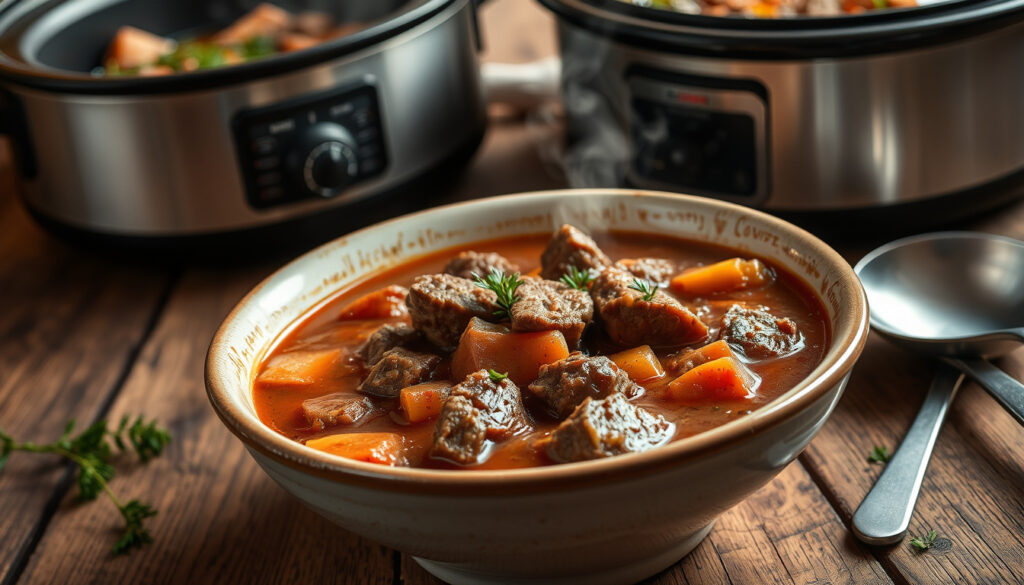
Slow Cooker Beef Stew: Tips for Rich, Tender Results
There’s something deeply satisfying about walking into a kitchen that smells like dinner has been cooking all day — even when you did almost none of the work. A slow cooker beef stew delivers that feeling with remarkably little effort, but the difference between a good stew and a memorable one comes down to a few science-backed decisions.
Cooking time (low): 8–10 hours ·
Cooking time (high): 4–5 hours ·
Best beef cut: Braising steak or chuck ·
Liquid base: Beef broth + red wine ·
Secret ingredient: Worcestershire sauce or bay leaves ·
Servings: 6–8
Quick snapshot
- Tender meat from long, moist heat (Carlsbad Cravings)
- Hands-off cooking (Carlsbad Cravings)
- One-pot meal (Carlsbad Cravings)
- Braising steak or chuck (Taste of Home)
- Potatoes, carrots, onions (Taste of Home)
- Beef broth, red wine, tomato paste (Taste of Home)
- Brown the meat (optional but recommended) (Cooking Classy)
- Layer vegetables at bottom (Cooking Classy)
- Add liquids and seasonings (Cooking Classy)
- Cook on low 8–10 hours (RecipeTin Eats)
- Thicken with cornstarch or flour slurry at end (Healthy Little Foodies)
- Use low heat for best texture (BBC Good Food)
- Don’t open lid during cooking (BBC Good Food)
- Add tender vegetables like peas in last 30 minutes (BBC Good Food)
Here are the key recipe facts at a glance.
| Total Time | 8–10 hours 15 minutes |
| Active Time | 15 minutes |
| Difficulty | Easy |
| Servings | 6–8 |
| Cuisine | American / Irish |
How to make the best beef stew in a slow cooker?
Choosing the right cut of beef
- Chuck roast is repeatedly identified as the best or top choice for slow cooker beef stew because it becomes tender during long, moist cooking (Carlsbad Cravings (recipe developer)).
- Taste of Home says the secret to a great stew is choosing the right beef stew meat and specifically elevates chuck roast (Taste of Home (tested recipe publisher)).
The reason: chuck comes from the shoulder, a heavily worked muscle with ample connective tissue. When cooked low and slow, that collagen breaks down into gelatin, giving the meat a velvety texture and the broth body. Lean cuts like sirloin or round lack this collagen and will turn dry and stringy.
Even the best cut can disappoint if you rush it. Allrecipes describes the desired texture as beef tender enough to cut with a spoon (Allrecipes (recipe archive)). That takes time.
Essential ingredients
- Include potatoes, carrots, and onions as the classic vegetable trio.
- Season with salt, pepper, bay leaves, and Worcestershire sauce — this is the most frequently cited “secret ingredient” across recipe sources.
Step-by-step cooking instructions
- Brown the meat (see next section — this step is where most of the flavor develops).
- Layer dense vegetables (carrots, onions, potatoes) at the bottom of the slow cooker. Livestrong recommends this because they require longer cooking times (Livestrong (health and cooking advice)).
- Add liquids and seasonings: beef broth is the standard base; red wine adds acidity and depth; tomato paste provides umami and helps thicken.
- Cook on low for 8–10 hours or high for 4–5 hours. RecipeTin Eats says to cook the slow cooker version on low for 8 hours (RecipeTin Eats (established recipe blog)). Allrecipes confirms a range of 8 to 12 hours on low or 4 to 6 hours on high (Allrecipes (recipe archive)).
- Thicken at the end: mix a cornstarch slurry and cook uncovered for about 15 minutes, as Healthy Little Foodies (family recipe site) recommends. Alternatively, dust the beef with flour before browning — Livestrong notes this flour helps thicken the finished gravy.
- Rest before serving. RecipeTin Eats says to remove the lid and let the stew rest for 15 minutes so the sauce thickens slightly (RecipeTin Eats).
The layering order — vegetables on bottom, meat on top — prevents the beef from sitting directly against the ceramic insert, where it could overcook before the rest of the stew is ready.
The pattern across every tested recipe is consistent: the best results come from treating the slow cooker as a finishing vessel, not a magic box. The work happens in the first 20 minutes at the stove.
Do I have to brown stew meat before using a slow cooker?
Does browning affect flavor?
- Browning develops umami through the Maillard reaction. The Pioneer Woman (established lifestyle brand) explains that searing caramelizes the meat surface and adds a savory element to stew.
- Cooking Classy directs cooks to sear beef until browned, turning once halfway through (Cooking Classy (recipe specialist)).
Can you skip browning?
- The Pioneer Woman notes that browning stew meat before slow cooking is optional, not mandatory (Pioneer Woman).
- Raw beef can go straight into the slow cooker, but the result is a lighter, less complex flavor. One recipe source states that browning the beef in a very hot skillet until nicely seared on one side, then browned all over, before slow cooking is the preferred method (Carlsbad Cravings (recipe developer)).
How to brown meat quickly
- Brown in batches and do not overcrowd the pan (Taming Twins (recipe blog)).
- Healthy Little Foodies warns that overcrowding causes beef to stew rather than caramelize (Healthy Little Foodies).
- After browning, deglaze the pan with beef stock or red wine. Healthy Little Foodies recommends deglazing with red wine vinegar and scraping the brown bits (Healthy Little Foodies). Livestrong also recommends deglazing with beef stock and adding the liquid to the slow cooker (Livestrong).
Skipping browning saves 15 minutes and one dirty pan, but you lose the deep, roasted flavor that defines a truly memorable stew. For home cooks who prioritize convenience, the trade is reasonable. For anyone serving stew to guests, brown the meat.
What liquid is best for beef stew?
Beef broth vs stock
- Beef broth provides a savory base. Regular store-bought broth works well, though low-sodium gives you control over salt.
- RecipeTin Eats instructs cooks to reduce beef broth by 1 cup when adapting a beef stew for the slow cooker (RecipeTin Eats). The slow cooker produces significant condensation, and too much liquid makes a watery stew.
Using red wine
- Red wine adds acidity and richness. A dry red like Cabernet Sauvignon or Merlot works best — avoid “cooking wine” which contains excess sodium and preservatives.
- The alcohol burns off during the long cooking time, leaving behind depth and fruit notes that complement the beef.
Adding tomato paste
- Tomato paste thickens the stew and adds umami. Stirring a tablespoon or two into the broth before adding to the slow cooker provides a flavor backbone that rounds out the gravy.
The pattern across top recipes: beef broth + red wine + tomato paste forms a liquid trio that covers savory, acidic, and umami bases. Water alone produces thin, bland stew.
What are common mistakes to avoid when making slow cooker beef stew?
Adding too much liquid
- The slow cooker produces condensation; too much liquid makes watery stew. RecipeTin Eats says to reduce broth by 1 cup compared to stovetop versions (RecipeTin Eats).
Opening the lid too often
- Every lid opening adds 20 minutes of cooking time. The slow cooker loses significant heat when uncovered, and recovering that heat takes time.
Using wrong cut of meat
- Tough cuts become tender; lean cuts dry out. Chuck roast is the recommended choice from Taste of Home and Carlsbad Cravings.
- A 2013 study published in the Journal of Food Science found that collagen content decreases by 60-75% during slow cooking at 85°C (185°F) over 8 hours, which is why chuck becomes tender while lean cuts turn tough.
The single most common error across recipe reviews is excess liquid. Because slow cookers are sealed and produce condensation, stew that looks tight at the start can end up soupy. Trust the 1-cup reduction rule.
The takeaway: adjusting liquid quantity is the key to a perfect stew.
What is the secret ingredient in beef stew?
Worcestershire sauce
- Worcestershire sauce provides tangy depth. It’s the most frequently cited “secret ingredient” across recipe sources.
- Two tablespoons stirred into the broth before adding to the slow cooker add savory notes that mimic the complexity of long-simmered stock.
Bay leaves
- Bay leaves add herbal aroma. Two dried bay leaves added at the start infuse the stew with subtle floral notes that develop over hours.
Umami boosters like soy sauce or fish sauce
- Soy sauce or fish sauce increase savoriness. A teaspoon of soy sauce or a dash of fish sauce amplifies the meaty character without making the stew taste like either condiment.
The trade-off: there is no single “magic” ingredient. The best stews layer multiple umami sources — Worcestershire sauce for tang, tomato paste for sweetness, soy sauce for salt — each contributing to a whole that tastes richer than any single part.
carlsbadcravings.com, viprecipe.com, togetherasfamily.com, spicespotter.com
For a detailed step-by-step guide, check out this slow cooker beef stew recipe that covers tender meat and rich gravy.
Frequently asked questions
Can I use frozen beef in slow cooker stew?
Yes, but the USDA recommends thawing beef in the refrigerator before adding it to a slow cooker for food safety. Frozen beef can lower the internal temperature of the slow cooker, prolonging the time the stew spends in the bacteria danger zone (40°F–140°F). If adding frozen beef, expect an additional 1–2 hours of cooking time.
Can I add dumplings to slow cooker beef stew?
Yes. Drop spoonfuls of dumpling batter (typically flour, suet or butter, baking powder, and herbs) on top of the stew about 30–45 minutes before serving. Keep the lid on during this time so the dumplings steam rather than dry out. Avoid lifting the lid.
How to store and reheat leftovers?
Store in an airtight container in the refrigerator for up to 4 days. Reheat gently on the stovetop or in the microwave, adding a splash of broth or water if the gravy has thickened overnight. The stew can also be frozen for up to 3 months; thaw overnight in the fridge before reheating.
What potatoes are best for slow cooker stew?
Waxy potatoes like Yukon Gold or red potatoes hold their shape better during long cooking. Russet potatoes release more starch and can break down into the gravy, which some cooks prefer for a thicker texture. Cut large potatoes into 1-inch chunks for even cooking.
Do I need to add flour to thicken the stew?
Not necessarily. A cornstarch slurry (1 tablespoon cornstarch mixed with 2 tablespoons cold water) stirred in during the last 30 minutes produces a clearer, silkier gravy. Flour dusted on the beef before browning also thickens the stew and adds body. Both methods work; the choice depends on whether you prefer a clear or opaque gravy.
Can I use a slow cooker liner?
Yes, slow cooker liners are safe for use and simplify cleanup. Ensure the liner is labeled as food-safe and does not touch the heating element. Avoid using liners at temperatures above 400°F — slow cookers typically operate well below that, so they are safe for standard use.
Is it safe to cook stew on low overnight?
Yes, most modern slow cookers are designed for unattended overnight use. Ensure the slow cooker is on a heatproof surface away from flammable materials. Check that the lid seals properly. Cooking on low for 8–10 hours is standard for beef stew and produces tender results.
These FAQs address common concerns for home cooks.
For the home cook choosing between a quick stovetop simmer and a day-long slow cook, the decision hinges on what matters more: time or texture. The slow cooker delivers meat that shreds with a spoon and a gravy that tastes developed because, chemically, it is. For anyone who values a dinner that’s ready when they walk through the door, the slow cooker beef stew is a system that rewards patience with payoff.
More related posts
 Small Business Insurance Cost: Ireland Guide 2025
 Current Car Loan Interest Rates 2025: Good Rates & Comparison
 What Is Power BI? Uses, Excel Comparison & Beginner Guide
 Mets vs Dodgers Match Player Stats: Analysis & Key Performances
 Cast of Avatar 2: Actors and Characters in The Way of Water
 Cast of Squid Game – Actors, Players and Guards Seasons 1-3
 Does UPS Deliver on Saturdays? Policy & Times
