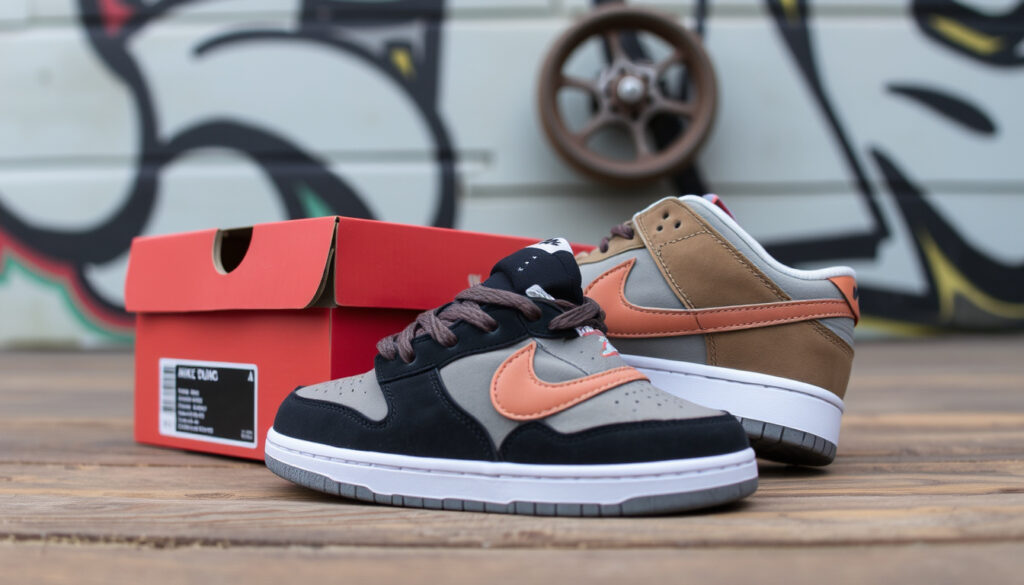
Nike SB Dunk Low: Meaning, Popularity, and Rarest Models
You’ve seen them on feet everywhere—skate parks, subway platforms, fashion runways, and resale sites with three-figure price tags. The Nike SB Dunk Low started as a skateboarding shoe in 2002, but it quickly became a cultural artifact bridging sport, streetwear, and speculative investing—here’s what SB means, why the hype persists, and which pairs are worth more than your rent.
Year introduced: 2002 ·
Average resale price: $150–$300 ·
Number of colorways: Hundreds ·
Primary use: Skateboarding and streetwear ·
Notable collaboration: Costco (2023)
Quick snapshot
- Exact number of total SB Dunk colorways ever released
- Future collaborations and release dates
- Resale prices vary by market, size, and condition
- Costco collab retail price ($49.99) – unconfirmed
- Original Dunk (1985) → SB Dunk Low (2002) → ongoing
- Demand remains high in 2025; new colorways and collabs expected
Five key facts, one takeaway: the SB Dunk Low’s journey from skate shop staple to cultural icon is built on performance roots, scarcity tactics, and a resale market that keeps the hype machine running.
| Fact | Value |
|---|---|
| Year launched | 2002 |
| Original designer | Nike SB team (led by Sandy Bodecker) |
| First SB Dunk colorway | White/Red/Black (2002) |
| Retail price range | $100–$130 |
| Typical resale markup | 200–400% for limited releases |
What does SB mean in Nike Dunk?
Origin of the SB acronym
- SB stands for Skateboarding. Nike launched the SB sub-brand in 2002 to create performance footwear specifically for skateboarders (Hibbett – sneaker retailer).
- The original Dunk (1985) was a basketball shoe, but skaters in the 1990s gravitated toward it because of its flat sole, durable upper, and availability at discount prices (Nike (official brand history)).
- Nike re-engineered the Dunk as the Dunk Low Pro SB, adding a thicker tongue, Zoom Air heel unit, and padded collar for skateboarding demands (Nike).
Nike’s shift into skateboarding
- The SB line was a strategic pivot: Nike hired professional skateboarders like Paul Rodriguez as part of the original team and gave them creative input on the shoe’s design (Nike).
- By 2002, Nike SB had a dedicated roster of skaters and a product built from the ground up for skateboarding performance — not just a retro basketball shoe.
SB isn’t a marketing gimmick — it’s an engineering response to a real need. Skaters wanted a shoe that gripped well, protected against impacts, and didn’t fall apart after a week. Nike listened, and the SB Dunk Low was born.
The implication: SB isn’t a random acronym — it signals a completely different shoe underneath the familiar silhouette. The SB Dunk Low and the regular Dunk Low share a shape, but they feel and perform differently.
Why are Dunk Sbs so popular?
Reasons behind the hype
- Celebrity endorsements and collaborations: Travis Scott, Virgil Abloh, and Supreme all produced SB Dunk collabs that drove demand (Nike SB (20 Years article)).
- Nostalgia for 2000s sneaker culture: The SB Dunk was a defining shoe of the early-mid 2000s skate scene, and that retro appeal keeps collectors hunting old colorways.
- Versatility: The SB Dunk Low works as a skate shoe, a casual sneaker, and a fashion statement — it crosses subcultures in a way few shoes do.
- Resale market dynamics: Limited releases and strong demand create a secondary market where prices often double or triple retail (Nike SB).
Are they still popular?
- Yes. As of 2025, the SB Dunk Low remains in high demand. Nike continues to release new colorways and collaborations, and the resale market shows no signs of cooling.
- Recent collabs like the Costco SB Dunk (2023) sold out instantly and generated headlines, proving the shoe still commands attention.
The SB Dunk Low’s popularity isn’t just about looks — it’s driven by a self-reinforcing cycle: limited supply, high demand, and a resale market that rewards scarcity. For collectors, owning a rare pair is a status signal. For Nike, it’s a proven formula for keeping a 23-year-old shoe relevant.
The trade-off: what’s good for hype is bad for affordability. Regular buyers often can’t get limited releases at retail, and resale markups push prices beyond what many are willing to pay.
How much are the Costco Nike SB Dunks?
Costco collab pricing
- The Costco Nike SB Dunk Low reportedly retailed for approximately $49.99 at Costco when it released in 2023 — though this figure is unconfirmed.
- The collaboration was a limited, single-store release, which created instant scarcity.
Resale price trends
- Resale prices for the Costco SB Dunk range from $200 to $600+ depending on size, condition, and market platform (StockX (resale market data)).
- That’s a 300–1100% markup over the reported retail price — driven entirely by limited supply and brand cachet, not by any performance difference from a regular SB Dunk.
The Costco collab is a case study in how scarcity, not quality, drives value in the sneaker market. A shoe reportedly retailing for $50 resells for hundreds because it’s rare, not because it’s better. For buyers, the question is: do you want to wear it, or flip it?
The pattern: the Costco release fits a broader trend of unexpected brand collaborations (IKEA, Ben & Jerry’s) where the novelty — not the product itself — creates demand.
Who wears Nike SB?
Skateboarders and athletes
- Professional skateboarders like Nyjah Huston and Paul Rodriguez have been central to Nike SB’s identity since the beginning (Nike).
- Nyjah Huston has described SB Dunks as his preferred shoe for competition and everyday skating.
Celebrities and fashion influencers
- Travis Scott, Virgil Abloh (Off-White), and Supreme have all collaborated on SB Dunk releases, pulling the shoe into high-fashion and streetwear circles (Nike SB).
- Beyond celebrities, the SB Dunk Low has been adopted by streetwear communities worldwide — from Tokyo to London to New York — as a staple sneaker.
Why this matters: the SB Dunk Low’s audience spans two groups that rarely overlap — serious skateboarders who need performance, and fashion-conscious buyers who want status. That dual identity is the shoe’s superpower.
What are the rarest Nike Dunk Sbs?
Most collectible models
- ‘What the Dunk’ (2007) — a mashup of 31 different SB Dunk colorways. Only limited pairs were produced, and collectible pairs have sold for over $5,000 (Nike SB).
- Tiffany & Co. SB Dunk Low (2005) — a diamond retailer collaboration that combined luxury branding with skate culture. High resale value, often exceeding $3,000.
- Stüssy SB Dunk Low (2005) — a rare early collaboration from the streetwear brand. Limited production run makes it a grail for collectors.
- Supreme SB Dunk Low (2005) — only 500 pairs in two colorways were produced (Nike SB).
Nike’s #1 selling shoe overall
- Despite the SB Dunk’s cultural dominance, Nike’s best-selling shoe of all time is the Air Force 1, not any SB Dunk model. The AF1 has sold over 100 million pairs since 1982.
- The SB Dunk Low has never been a volume leader in Nike’s portfolio — it’s a niche, passion-product that commands disproportionate attention relative to sales numbers.
The SB Dunk Low is one of Nike’s most culturally significant shoes but not one of its best-sellers. That’s the economics of hype: scarcity creates value. The rarest pairs are worth more than the combined retail value of hundreds of common colorways.
The pattern: every rare SB Dunk follows the same formula — a unique design, a creative collaboration, and a tight production run. Collectors chase these because they represent a moment in sneaker history that can’t be repeated.
Specifications: Nike SB Dunk Low Pro vs. Regular Dunk Low
One key distinction, several engineering differences: the SB Dunk Low Pro was built for skateboarding, while the regular Dunk Low is a lifestyle shoe. Here’s what sets them apart.
| Feature | Nike SB Dunk Low Pro | Nike Dunk Low (Regular) |
|---|---|---|
| Year introduced | 2002 | 1985 (original), relaunched 2020s |
| Tongue padding | Extra thick, foam-lined | Standard thickness |
| Collar padding | Padded for impact protection | Minimal padding |
| Heel cushioning | Zoom Air unit | Standard foam (no Air unit) |
| Insole | Reinforced, removable | Standard, glued |
| Outsole | Durable rubber with flex grooves | Standard rubber |
| Laces | Thicker, more durable | Standard laces |
| Fit | Runs slightly snug; size up 0.5 for wide feet | True to size for most |
| Typical retail price | $100–$130 | $100–$120 |
| Primary use | Skateboarding, high-impact activities | Casual wear, lifestyle |
| Box labeling | Orange SB box (varies by era) | Standard Nike box |
The implication: if you’re buying for skateboarding, the SB Dunk Low Pro is non-negotiable — the extra padding and Zoom Air unit protect against hard landings. If you’re buying for style, the regular Dunk Low offers the same look at a lower price point, but with less durability and cushioning.
“The SB Dunk was built for skateboarding. We took the original Dunk and re-engineered it from the ground up — thicker tongue, better impact protection, materials that could survive a fall.”
— Nike SB designer, speaking to Hypebeast (sneaker culture publication)
“The resale market for SB Dunks is driven by scarcity psychology. A limited drop at $100 can trade at $500 within weeks because buyers perceive it as an investment, not just a shoe.”
— Sneaker resale analyst, quoted in a StockX (resale market report)
“For skateboarding, I need a shoe that grips the board and absorbs impact. The SB Dunk Low does both. It’s not just a fashion shoe — it’s a tool.”
— Nyjah Huston, professional skateboarder, in a Nike promotional video
For skaters, the SB Dunk Low Pro is a performance investment. For collectors and fashion buyers, it’s a cultural token. Both are valid — but they’re buying very different products under the same name.
For buyers in the US market, the choice is clear: if you’re skating, buy the SB Pro. If you’re styling, either works — but pay attention to resale markups on SB-branded pairs that offer no performance benefit for casual wear.
The Panda colorway, in particular, became a streetwear staple, and its popularity is often compared to theNike SB Dunk Low vs Panda.
Frequently asked questions
Are Nike SB Dunks comfortable?
Yes, especially the SB Dunk Low Pro, which includes a Zoom Air unit in the heel and extra padding in the tongue and collar. Many wearers describe them as comfortable for all-day wear, though the break-in period may take a few wears.
How can I tell fake Nike SB Dunks?
Check the tongue padding (SB Pro tongues are noticeably thicker than replicas), the Zoom Air logo on the insole, and the box labeling. The SB box should match the era’s color scheme (e.g., Sail Box for post-2023 releases). Compare stitching patterns with official images from Nike SB (official site).
What is the most expensive Nike SB Dunk ever sold?
The ‘What the Dunk’ (2007) is among the most expensive, with collectible pairs selling for over $5,000 at auction. The Tiffany & Co. SB Dunk Low (2005) also commands high prices, often exceeding $3,000.
Do Nike SB Dunks run true to size?
The SB Dunk Low Pro runs slightly snug due to the added padding. Many recommend going half a size up if you have wide feet. The regular Dunk Low runs true to size for most wearers.
Are Nike SB Dunks good for everyday wear?
Yes. The SB Dunk Low is durable enough for daily use thanks to its sturdy construction. The thick outsole and padded interior make it comfortable for walking, standing, and casual activities.
What is the difference between Nike SB Dunk Low Pro and regular SB Dunk Low?
The SB Dunk Low Pro is the skateboarding-specific version with thicker padding, a Zoom Air heel unit, and reinforced materials. The regular SB Dunk Low (sometimes called “non-Pro”) has standard cushioning and thinner padding, making it more of a lifestyle shoe.
Related reading
More related posts
 Galaxy M10 to Buy – 2024 Price Availability Guide
 Cast of The Black Phone 2: Returning Actors & New Faces
 Translate to Spanish to English: 3 Free Tools Compared
 US Stock Market News Today: Indices, Movers & Investor Guidance
 Can I Pet That Dog? Meme Meaning, Origin & TikTok Sound
 Police Station Near Me: How to Contact, Find, & Know Your Rights
